Showing posts with label big12. Show all posts

Tuesday, December 18, 2012

The Big 12 vs. Pac-12 debate


The Big 12 and Pac-12 are feeling a lot like kindred spirits these days. Complaints about the effects of a nine-game conference schedule fell on mostly deaf ears, but after two years through the wringer, the Big 12 can suddenly relate.
The true effects of the schedule are debatable. What's not is that it drops a bushelful of losses in both leagues' tanks that aren't there while the Big Ten beats up on (or, in this year's case, loses to) some MAC teams or the SEC runs up the score on the Sun Belt.
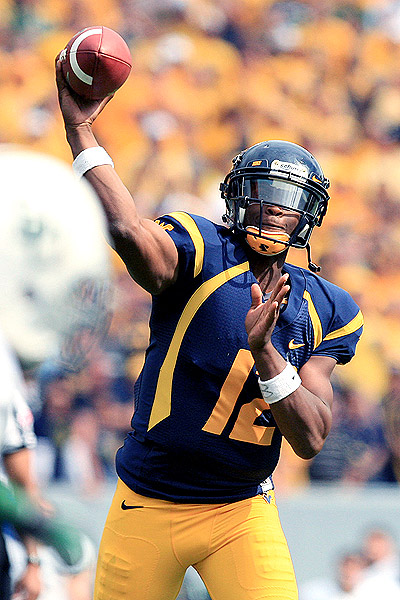
Geno Smith

Geno Smith and WVU didn't finish strong, but they add to the Big 12's depth.
Half of the Big 12 (five teams) is exactly 7-5, including hyped preseason contender West Virginia, which loves to chuck it around with one-time Heisman front-runner Geno Smith.
The Pac-12 had four teams finish 7-5 in the regular season, including hyped preseason favorite USC, which loves to chuck it around with one-time Heisman front-runner Matt Barkley.
But which league is better? The Big 12 and Pac-12 have battled for the No. 2 spot behind the (*cough* …top-heavy) SEC all season.
Our ESPN Stats & Information team says the Pac-12 has the edge on the Big 12 for now, but the Big 12 was No. 1 early in the season and No. 2 until late November.
Me? I don't buy it. Part of the issue for the Big 12 is that surplus of 7-5 teams. You won't be in the polls if you're 7-5, but you'll be mighty, mighty close. None of the Big 12's five 7-5 teams were ranked, though four received a total of 75 votes, which combined still wouldn't have been enough to grab the No. 25 spot in the media poll.
But the computers? They factor in every team in the league, and there's no debate there. The Big 12 is the No. 1 league in college football according to the computers, and the Pac-12 is all the way back at No. 3.
There's not a league that can compete with the Big 12's depth, and at the top of the two conferences, there's plenty of debate.
Both Oregon and Stanford won 11 games, but Stanford won only 11 games because it got to beat UCLA in consecutive weekends, counting the Pac-12 championship. Kansas State won 11, but Oklahoma won 10 games with losses to K-State and national title participant Notre Dame.
The top of the two conferences might offer a slight edge to the Pac-12, but it's certainly close to a push at the top. There's no debate at the bottom, though.
The Pac-12 is partly to thank for that. You'll have to excuse the Big 12 if it's not missing Colorado very much these days. The Big 12 has clearly proved itself as the deepest league in college football, even if it can't match what the Pac-12 boasts in the top 15 of the polls.
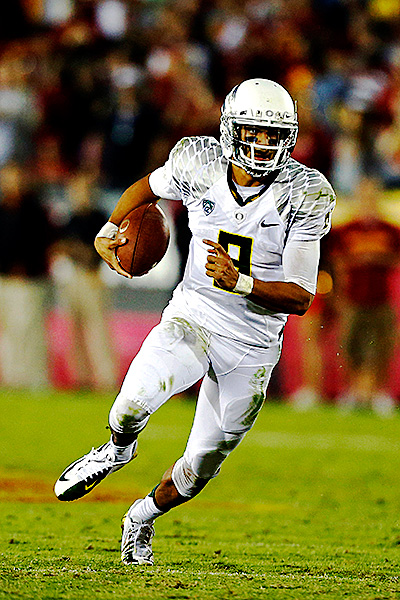
Marcus Mariota

Want to make a statement, Big 12? Shut down Marcus Mariota in the Fiesta Bowl.
Neither league has a BCS title participant thanks to a painful Nov. 17 night when Oregon dropped an overtime game against Stanford and Kansas State dropped the ball in a blowout road loss to Baylor, one of the five 7-5 teams in the Big 12.
Both leagues, though, have two very good teams, though the Pac-12 will send two teams to the BCS. K-State and Oregon will meet in the Fiesta Bowl, and Stanford will represent the Pac-12 in the Rose Bowl against five-loss Wisconsin.
Oklahoma would be in the BCS if the Big Ten or Big East were any good (or eligible, but that's another discussion), but Northern Illinois pushed the Sooners out of the BCS, even though Oklahoma's Cotton Bowl opponent (Texas A&M) will offer twice the challenge of the Badgers in Pasadena.
The Big 12 has the edge on the Pac-12, but there's good news in a sport in which far too much is decided on hard drives and on voters' ballots. The two leagues will play each other in three bowl games. Baylor and UCLA will meet in the Holiday Bowl. Texas and Oregon State will be a matchup of two Top 25 teams in the Alamo Bowl, and as we mentioned before, K-State and Oregon will play the biggest bowl game of the year between two Top 25 teams outside of the title game.
Debate the merits of both leagues now, but those three games will help settle the debate on the field.
Until then, this is the truth: The Big 12 is No. 2. At ESPN.com.

Monday, February 13, 2012

NCAA attendance hits new high

"A record number of fans attended games at the 638 NCAA football-sponsoring schools this past year, including home games, neutral-site games and postseason contests. The total of 49,699,419 surpasses the previous high set last year. NCAA football has experienced record-breaking years in five of the past six seasons.
Although overall attendance was up, the Division I Football Bowl Subdivision saw a decline from its record numbers of 2010. The FBS had its fourth-highest total ever with 37,411,795 fans for an average of 46,074 per game, which was down 544 fans a game from the previous year.
However, the Football Championship Subdivision and Division II set records to more than make up for the drop in the FBS. The FCS totaled 6,407,059 fans to break a record set in 1994. Division II had 3,035,696 spectators to break its mark set in 2007. With 2,381,454 fans, Division III recorded his second-highest total ever and the most since its record-breaking year of 1978.
Michigan’s 112,179 fans per game during eight home contests set an all-time mark for individual schools. The Wolverines broke their own record of 111,825 set in 2010. It was Michigan’s 14th consecutive attendance title.
Four other programs also topped the 100,000 mark -- Ohio State at 105,231, Alabama at 101,821, Penn State at 101,427, and Texas at 100,524. This was the fifth consecutive year that Big Ten Conference teams held the top three spots.
Despite that, though, the Southeastern Conference was the best Division I league draw for the 14th consecutive year. SEC schools claimed six of the top 11 spots.
Other highlights
• The SEC totaled 6,369,898 fans while averaging 75,832 per game, just shy of the SEC’s all-time conference record of 76,844 in 2008.
• The Big Ten (71,439), Big 12 (63,265), Pac 12 (52,249) and Atlantic Coast (51,406) rounded out the top five in conference attendance.
• Four FBS and three FCS conferences set personal highs for total attendance. The FBS conferences were the Big Ten, Pac-12, Big East and Sun Belt. The FCS conferences were the Colonial, Missouri Valley Football and Big South.
• The average number of fans attending an FCS game was 9,620, an increase of 196 fans per game from 2010.
• The FBS postseason featured 35 bowl games that attracted 1,765,224 spectators for an average of 50,435 per contest.
• As for NCAA championship tournaments, total attendance for the FCS tournament was 256,384 for a 13,494 average across 19 playoff games. The Division II tournament totaled 123,528 fans for a 5,371 average in 23 games. The Division III tournament had 58,746 total fans for a 1,895 average across 31 games.
• Michigan, which was the first school to average more than 100,000 a game (in 1976), has captured the attendance title 42 times since 1949, including 36 since 1974.
• For all-games attendance -- including home, road and neutral-site games -- Michigan was tops as 1,218,043 fans watched the Wolverines across 13 games. Thirteen teams played in front of more than 1 million fans this season.
• Five FBS teams enjoyed increased crowds of more than 7,000 fans per game from last year. Leading the way was Louisiana-Lafayette, which benefitted from the excitement of a new coach (Mark Hudspeth), winning all of its home games and tying a school mark of nine wins in a season. Louisiana-Lafayette enjoyed an 11,788-person increase per game from 2010 to 2011. The Ragin’ Cajuns were followed by Arizona State (11,064), Stanford (9,954), Iowa State (8,251) and Temple (7,545).
• Appalachian State led FCS attendance for the fourth time in five years with an average of 26,211 fans per game. Second to the Mountaineers was James Madison’s average of 25,002. Montana was tops in the subdivision in total attendance at 199,023 in eight games.
• Among FCS conferences, the Southwestern Athletic Conference enjoyed its 33rd attendance title in 34 years. The 10 SWAC teams averaged 12,944 fans per game and totaled 686,051 spectators. The Southern (679,491 fans for an average of 12,821) and the Colonial Athletic (754,705 fans for an average of 12,173) were a close second and third, respectively.
• In Division II, Morehouse captured its first attendance title by averaging 11,713 fans per game. The three other schools that averaged more than 10,000 per game were Tuskegee (11,458), Grand Valley State (10,478) and Miles (10,188).
• The Southern Intercollegiate Athletic Conference posted its 19th Division II attendance title in 20 years. SIAC teams averaged 8,164 fans per game. Next were the Gulf South at 6,255 and the Lone Star with 6,209 fans per game.
• In Division III, Hampden-Sydney stopped a run of 10 straight attendance titles by St. John’s (Minnesota). Hampden-Sydney’s 7,997 fans per game edged St. John’s average of 7,699. The rest of the top five were Wisconsin-Whitewater (5,175), Randolph-Macon (5,169) and Concordia-Morehead (4,685).
• Also in Division III, the Minnesota Intercollegiate Conference won its sixth title in seven years with 3,503 fans per game. The Old Dominion Athletic Conference finished second by averaging 3,498 fans per game, just five less fans per game than the champion. The ODAC was the attendance champion in 14 of 16 years from 1989 to 2004." at ncaa.com